

Formerly LL.M. in Transnational Crime and Justice
Blended modality
The Master of Laws (LL.M.) in Global Criminal Justice and Accountability (formerly Transnational Crime and Justice), jointly organized by the United Nations Interregional Crime and Justice Research Institute (UNICRI) and by the University for Peace (UPEACE), is designed for graduates and professionals seeking advanced knowledge and expertise in international criminal justice and atrocity crimes accountability.
The programme’s shift to global criminal justice and accountability,reflects its evolution over the past nine years. While transnational crimes and global security threats, remain an important component, the curriculum has expanded and now offers a comprehensive and practice-oriented coverage of international criminal law, atrocity crime accountability, human rights, humanitarian law, and justice in conflict and post-conflict settings. The proposed new title aims to more accurately represent the programme’s academic content and identity in a competitive global field, and better signal to prospective students and employers the specific expertise developed through this LL.M. with a title that aligns with the programme’s core focus and enhances clarity, coherence, and professional relevance for both recent graduates and early- to mid-career practitioners. The updated name captures the programme’s expanded and contemporary focus on urgent justice challenges - from atrocity crimes to emerging global threats. The programme’s mission, to the contrary, remains the same: to equip graduates with the knowledge and skills to drive meaningful justice advancement at a global level.
Depending on each student’s background and interest, the programme is functional for careers in the legal and judicial sectors both at a national and international level as well in further academic studies.
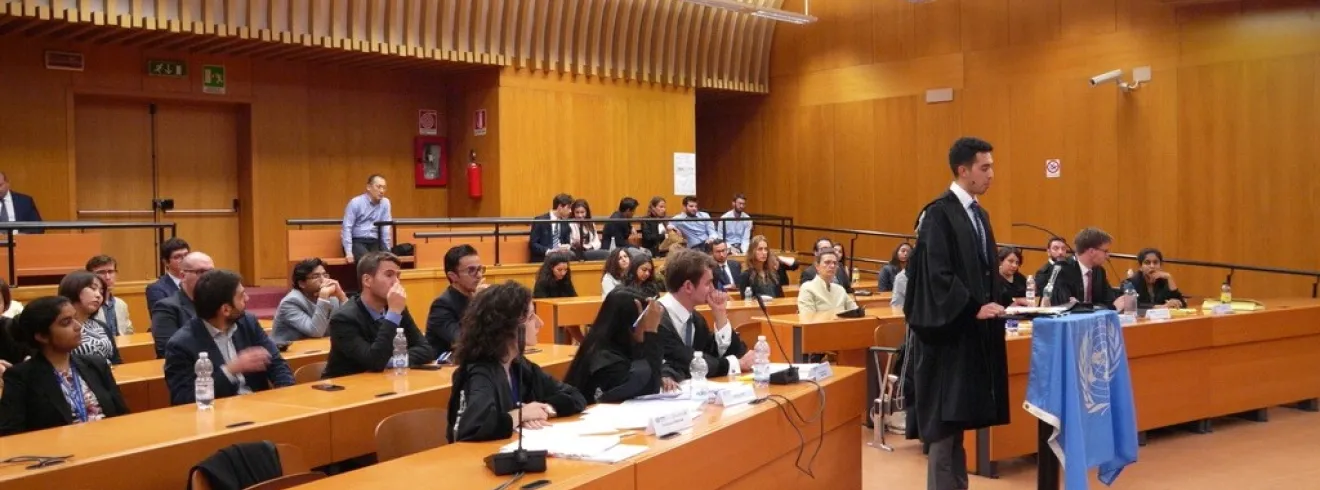
Through a combination of lectures, seminars, group activities and a Moot Court competition, selected students will acquire:
in-depth knowledge on the theoretical and practical aspects related to the investigation, prosecution and adjudication of international crimes and human rights violations.
overall comprehension of the functioning of international criminal tribunals, special and hybrid courts and their legacy to national courts;
familiarity with the principle of rule of law and thorough understanding of the interdisciplinary processes and mechanisms related to transitional justice and justice reform in post-conflict situations and countries in transition;
unique insights into the policies and tools of the United Nations, other international organizations as well as national bodies for the prevention, investigation, control and punishment of transnational organized crime, including corruption, trafficking in persons, smuggling of migrants, environmental crimes, terrorism, and cybercrime.
Below is a brief description of UNICRI and UPEACE, the Master organizers:
UNICRI is one of the main training and research institutes of the UN System. It was established in 1968 and is mandated to support countries worldwide in preventing crime and promoting criminal justice. Over the years the Institute has developed a sound expertise in research and training, which is reflected in the organization of several capacity-building activities and specialized postgraduate courses. The residential phase of the programme is held in the unparalleled setting of the United Nations Campus in Turin, Italy. The Campus is located on 10 hectares of riverside parkland and hosts other national and international organizations such as the ITC-ILO and UNSSC. Under regular circumstances, it annually runs more than 450 programmes and projects involving approximately 11,000 people from over 180 countries, also offering to its guests leisure, dining, and sports facilities.
UPEACE headquartered in Costa Rica, is a Treaty Organization established in 1980 through an International Agreement approved by the United Nations General Assembly in Resolution 35/55, and has the mandate “to provide humanity with an international institution of higher education for peace and with the aim of promoting among all human beings the spirit of understanding, tolerance and peaceful coexistence, to stimulate cooperation among peoples and to help lessen obstacles and threats to world peace and progress, in keeping with the noble aspirations proclaimed in the Charter of the United Nations”. By virtue of the mandate granted to it by Article 15 of the Charter of the University for Peace, annexed to the International Agreement Establishing the University for Peace, UPEACE conducts master’s and Doctorate Degree programmes in fields that promote peace and security.
Structure and academic information
The LL.M. is characterized by an interdisciplinary academic strategy that integrates theory and practice, favours active exchange of ideas, and furthers the comparative and critical thinking skills of students.
The academic curriculum of the programme unfolds in two phases:
During the Distance-learning Phase (16 November 2026 – 8 January 2027), students will have access to the LL.M. Programme’s e-learning platform, where in addition to self-study, they will participate in webinars, carry out group projects and engage in other interactive activities with the support of an Academic Advisor. At the end of this phase, students will take an exam.
The Residential Phase (27 January 2027 – 25 June 2027) comprises theoretical lectures, seminars, and practical activities including workshops, study visits and a Moot Court competition (led by prominent subject-matter experts and scholars), organized in cooperation with international organizations, NGOs, research institutions and entities belonging to the UN System. The international group of selected students will be attending classes both in the morning and in the afternoon (full-time commitment for 6 class hours a day/4-5 days a week) at the UN Campus. The programme further envisages dedicated sessions on career guidance and professional development, including reference to the UN System. Students will have the opportunity to interact with human resources specialists and participate in an outreach session led by the United Nations Volunteers (UNV) programme.
The Graduation Project, at the end of the residential phase, will consist of a Moot Court simulation of selected aspects of proceedings before the International Criminal Court (ICC), helping students refine their skills in written and oral courtroom advocacy on selected issues of substantive international criminal law.
Full-time attendance is compulsory to be awarded the degree.
To be awarded the final Master of Laws Degree worth 40 UPEACE credits (equivalent to 40 US credits/60 ECTS), students need to comply with the following criteria:
a. receive passing marks in all the assessments and foreseen exams and
b. meet the minimum average of attendance by attending at least 2/3 of each weekly schedule and at least 75% of the total residential phase.
Upon successful completion of the course, students will be awarded an LL.M. degree officially issued by the University for Peace.
Faculty
The Faculty of the Master of Laws (LL.M.) in Global Criminal Justice and Accountability is composed of international academics, including UPEACE distinguished faculty members, UNICRI and UN staff members, international experts and practitioners. The faculty members, over the years, have included:
UPEACE faculty members:
Juan Carlos Sainz-Borgo – Vice Rector of the University for Peace (UPEACE); Former Associate Professor of International Law at the Central University of Venezuela in Caracas and Professor of Humanitarian International Law at the Universidad Sergio Arboleda in Bogota (Colombia); Former Fulbright Visiting Professor at the Washington College of Law at American University (USA); Former Jurist to the Regional Delegation of Venezuela and the Caribbean of the International Committee of the Red Cross (ICRC).
Mihir Kanade – Academic Coordinator of the University for Peace (UPEACE), Head of UPEACE’s Department of International Law, Director of the UPEACE Human Rights Centre; Member of the UN Human Rights Council’s Expert Mechanism on the Right to Development, Former lawyer in the Supreme Court of India and the Bombay High Court, focusing on issues of fundamental human rights violations; Adjunct faculty at Universidad Alfonso XI El Sabio (Spain), Long Island University (USA), and Universidad de Los Andes (Colombia). Co-coordinator of the Master programme.
Mariateresa Garrido – Assistant Professor of International Law, Department of International Law at the University for Peace (UPEACE) and UPEACE Doctoral Program Coordinator.
Keynote speakers:
Adama Dieng – Former Special Adviser to the United Nations Secretary General on the Prevention of Genocide; Former Registrar of the International Criminal Tribunal for Rwanda (ICTR).
Alice Wairimu Nderitu – Former Special Adviser to the United Nations Secretary General on the Prevention of Genocide.
Christoph Safferling – Director, International Nuremberg Principles Academy; Chair of Criminal Law, Criminal Procedure, International Criminal Law, and Public International Law, Friedrich-Alexander University Erlangen–Nuremberg (Erlangen, Germany).
Fatou Bensouda – Former Chief Prosecutor of the International Criminal Court (ICC), 2012-2021.
Joanna Korner – Judge, International Criminal Court (ICC), former Senior Legal Adviser to the Chief Prosecutor of Bosnia and Herzegovina.
Navi Pillay – Judge ad hoc of the International Court of Justice (ICJ); President of the Advisory Council of the Nuremberg Principles Academy (Nuremberg, Germany); President of The International Commission against the Death Penalty (ICDP); Former United Nations High Commissioner for Human Rights; Former President of the International Criminal Tribunal for Rwanda (ICTR); Former Judge of the International Criminal Court (ICC).
Nazhat Shameem Khan – Deputy Prosecutor of the International Criminal Court (ICC), 2021-present.
Paola Gaeta – Co-President of the Geneva Academy of International Humanitarian Law and Human Rights, Professor of International Law at the Geneva Graduate Institute of International and Development Studies (Geneva, Switzerland).
Lecturers:
Abigail Bridgman – Member of California Bar and United States District Court of Northern California (USA); Former Assistant to Counsel at International Criminal Court (ICC).
Alice Riccardi – Senior Research Fellow in International Law, University of Roma Tre (Rome, Italy).
Andrea Di Nicola – Director, Centre of Security and Crime Sciences (Universities of Trento and Verona, Italy); Associate Professor of Criminology, Faculty of Law, University of Trento (Trento, Italy).
Ania Salinas Cerda – Senior Legal Officer, International Criminal Court (ICC).
Anna Maddrick – Legal Adviser on Climate, Permanent Mission of Vanuatu to the United Nations, New York.
Antonio Giovanni Luzzi – Head of Strategic Analysis, Terrorism Prevention Branch, United Nations Office on Drugs and Crime (UNODC).
Anushka Sehmi – Legal Officer, United Nations Kosovo; Former Assistant to Counsel, Defence Team for Dominic Ongwen, International Criminal Court (ICC).
Bakhtiyar Tuzmukhamedov – Member of the Committee Against Torture (CAT); Former Judge in the Appeals Chamber of the International Criminal Tribunals for the Former Yugoslavia (ICTY) and for Rwanda (ICTR).
Beti Hohler – Judge, Trial Division, International Criminal Court (ICC); Former Trial Lawyer, Office of the Prosecutor, International Criminal Court; Former Legal Officer to International Judges, European Union Rule of Law Mission in Kosovo (EULEX Kosovo).
Calogero Ferrara – Deputy Prosecutor at the Office of the Prosecutor in Palermo, Italy. Delegated Prosecutor at the European Public Prosecution Office (EPPO).
Carlotta Sami – Senior Regional Public Information Officer, Spokesperson, Office of the United Nations High Commissioner for Refugees (UNHCR).
Carola Lingaas-Louwerse – Associate Professor of Law, University of Oslo, Law Faculty (Oslo, Norway).
Christopher Black – International Criminal Lawyer; Counsel on the List of the International Criminal Court (ICC); Former Lead Counsel at the International Criminal Tribunal for Rwanda (ICTR).
Davyth Stewart – Coordinator, Global Forestry Enforcement and Pollution Crime Unit, International Criminal Police Organization (INTERPOL).
Elena Atzeni – Integration Associate, Office of the United Nations High Commissioner for Refugees (UNHCR).
Elena Dal Santo – Programme Management Officer, United Nations Interregional Crime and Research Institute (UNICRI).
Elena Maculan – Professor of Criminal Law, Department of Criminal Law and Criminology, Instituto Universitario General Gutiérrez Mellado (Madrid, Spain).
Elke Evrard - Postdoctoral Researcher at the Faculty of Law and Criminology, Department of European, Public and International Law, University of Ghent (Ghent, Belgium).
Emiliano Buis – Professor of International Law, Law School at the University of Buenos Aires (Buenos Aires, Argentina).
Eric Talbot Jensen – Professor of Law, Brigham Young University (Provo, USA); Former Special Counsel to the General Counsel, U.S. Department of Defense; Former Judge Advocate and Cavalry Officer, United States Army.
Fabricio Guariglia – Director, The Hague Branch Office, International Development Law Organization (IDLO); Former Director of Prosecutions, Office of the Prosecutor, International Criminal Court (ICC).
Francesco Marciano – Legal Advisor for the Armed Forces, Office of International Humanitarian Law, Training and Development Section, National Inspectorate of the Military Corps (Rome, Italy).
Francesco Marone – Assistant Professor of Political Science, University of Teramo (Teramo, Italy); Associate Research Fellow, Italian Institute for International Political Studies (ISPI).
Gabriele Baratto – Assistant Professor in Criminology, Faculty of Law University of Trento (Trento, Italy), Scientific Coordinator, eCrime, Faculty of Law University of Trento (Trento, Italy) and Member of the Centre of Security and Crime Sciences (Universities of Trento and Verona, Italy).
Gal Harmat – Senior Fellow at Swisspeace Institute (Basel, Switzerland).
Gary Hill (recently passed) – Member of the Board and Training Chair, International Corrections and Prisons Association (ICPA); Scientific Coordinator of the International Scientific and Professional Advisory Council, the United Nations Crime Prevention and Criminal Justice Programme Network (PNI); Chief Executive Officer, CEGA Services (Lincoln, USA) operating in Haiti, Rwanda and Kosovo.
Lt. Col. (ret.) Geoffrey S. Corn – George R. Killam Jr. Chair of Criminal Law and Director of the Center for Military Law and Policy, Texas Tech University School of Law (USA); Formerly Special Assistant to The Judge Advocate General for Law of War Matters/Chief of the Law of War Branch, International and Operational Law Division, Office of the Judge Advocate General, US Army; Chief of Criminal Law and Senior Criminal Trial Attorney, Office of the Staff Judge Advocate, 101st Airborne Division and Fort Campbell, US Army.
Ghenadie Barba – Chief, Rule of Law Unit, Office for Democratic Institution and Human Rights, Organization for Security and Co-operation in Europe (OSCE).
Lt. Col. Gianluca Mascherano – Military Researcher, Post-Conflict Operations Study Centre (PCOSC), Italian Army (Turin, Italy); Lecturer of Stabilization and Reconstruction Orientation Course, University of Turin (Turin, Italy).
Lt. Col. Gilberto Gagnone – Military Researcher, Post-Conflict Operations Study Centre (PCOSC), Italian Army (Turin, Italy).
Gregory Townsend – Former Chief of the Court Support Services Section, International Criminal Tribunal for the Former Yugoslavia (ICTY); Former Prosecutor, UN Mission to Kosovo; Former Head of Office, Special Court for Sierra Leone (STL).
Greig Klein – Assistant Professor of Terrorism and Political Violence of the Faculty Governance and Foreign Affairs, Institute of Security and Global Affairs, Leiden University Leiden, The Netherlands).
Guido Acquaviva – Lecturer, Geneva Academy of International Humanitarian Law and Human Rights (Geneva, Switzerland); Former Deputy Registrar, Kosovo Specialist Chambers; Former Chef de Cabinet, Office of the President, Special Tribunal for Lebanon (STL); Former Legal Officer, International Criminal Tribunal for the Former Yugoslavia (ICTY).
James Shaw – Senior Legal Officer, UNICRI.
James Kirkpatrick Stewart –Former Deputy Prosecutor, International Criminal Court (ICC); Former General Counsel, Crown Law Office – Criminal, Ministry of the Attorney General of Ontario, Canada; Former Chief of Prosecutions, Office of the Prosecutor, International Criminal Tribunal for the Former Yugoslavia (ICTY); Former Chief, Appeals and Legal Advisory Division, Office of the Prosecutor, International Criminal Tribunal for Rwanda (ICTR).
John McManus – Senior Legal Officer, Commission for International Justice and Accountability (CIJA).
John-Mark Iyi – Director, African Centre for Transnational Criminal Justice (ACTCJ), University of the Western Cape (Cape Town, South Africa).
Kai Ambos – Professor of Criminal Law and Criminal Procedure, Comparative Law, International Criminal Law, and Public International Law at Georg August Göttingen University (Göttingen, Germany); Judge, Kosovo Specialist Chambers; Advisor, (amicus curiae) Colombian Special Jurisdiction for Peace.
Karine Simonsen – Officer, Rule of Law Unit, Organization for Security and Co-operation in Europe (OSCE), Office for Democratic Institution and Human Rights.
Kristiina Kangaspunta – Former Chief of the Crime Research Section, United Nations Office on Drugs and Crime (UNODC); Former Deputy Director, United Nations Interregional Crime and Research Institute (UNICRI).
Laura Guercio – Coordinator of the Universities Network for Promoting the Rights of Children in Armed Conflicts; Professor of Sociology, University of Perugia (Perugia, Italy); Secretary General at the Inter-Ministerial Committee for Human Rights at the Italian Ministry of Foreign Affairs and International Cooperation (Rome, Italy).
Laurie R. Blank – Clinical Professor of Law, Director, International Humanitarian Law Clinic, Emory University School of Law (Atlanta, USA); Former Special Counsel to the General Counsel, U.S. Department of Defence.
Leif Villadsen – Acting Director, UNICRI.
Linda Carter – Distinguished Professor of Law Emerita, Mc George School of Law, University of Pacific (Sacramento, USA).
Marco Lombardi – Professor of Sociology and Director of the Sociology Department of the Catholic University of Sacro Cuore (Milan, Italy).
Marie O’Leary – Acting Principal Counsel, Office of Public Counsel for the Defence of the International Criminal Court (ICC-OPCD).
Marina Lostal Becerril – Senior Lecturer in Public International Law and Human Rights, University of Essex (Colchester, UK).
Mark Dietrich – Vice-President, East-West Management Institute (EWMI) (Geneva, Switzerland).
Martin Fowke – Team Leader, Normative and Policy Team, Human Trafficking & Migrant Smuggling Section, United Nations Office on Drugs and Crime (UNODC).
Maura Di Mauro – Trainer on Intercultural Communication, Adjunct Lecturer on Intercultural Business Management at Catholic University of Sacro Cuore (Milan, Italy).
Micol Azzaro – Community Engagement Officer, SOS Mediterranee Italia (Italy).
Nakako Onishi-Carcano – Former Legal Officer, Chambers, International Criminal Tribunal for the Former Yugoslavia (ICTY); Former Legal Officer, Chambers, Special Tribunal for Lebanon (STL).
Niccoló Pons – Senior Adviser on the Prosecution of International Crimes, EU Advisory Mission Ukraine; Senior Legal Advisor, Dignity – Danish Institute Against Torture; Legal Officer, Chambers of the Kosovo Specialist Chambers; Former Associate Legal Officer, Extraordinary Chambers in the Courts of Cambodia (ECCC) and International Criminal Court (ICC).
Nicola Lettieri – Alternate Judge at the Trial Chamber of the Special Tribunal for Lebanon (STL).
Nicolas Mansfield – Director of Legal Programs, East-West Management Institute (EWMI) (Geneva, Switzerland).
Nicolò Bussolati – Criminal Lawyer; Consultant in Legal and Cyber Issues; International Criminal Law Specialist. Academic Specialist of the Master Programme.
Nobuo Hayashi – Associate Professor, Swedish Defence University (Stockholm, Sweden); Senior Legal Advisor, International Law and Policy Institute (Oslo, Norway); Visiting Professor on International Humanitarian Law and International Criminal Law, International University of Japan (Niigata, Japan). Moot Court Coordinator of the Master programme.
Ola Quarnstrom – Officer, Rule of Law Unit, Office for Democratic Institution and Human Rights, Organization for Security and Co-operation in Europe (OSCE).
Olympia Bekou – Head, School of Law and Professor of Public International Law, University of Nottingham (Nottingham, UK).
Paolo Campana – Professor of Criminology and Complex Networks, Cambridge University (Cambridge, UK); Former Research Fellow at the Extra-Legal Governance Institute, Department of Sociology, University of Oxford (Oxford, UK); Former Fellow of Nuffield College, University of Oxford (Oxford, UK).
Col. Paolo Mazzuferi – Director the Post-Conflict Operations Study Centre (PCOSC), Italian Army (Turin, Italy).
Patricia Janega – International Trainer, Facilitator and Intercultural Expert, International Training Centre of the International Labour Organization (ILO); Intercultural Communications Trainer, Intercultures (Berlin, Germany).
Peter McCloskey – Former Senior Trial Attorney, Office of the Prosecutor, International Criminal Tribunal for Former Yugoslavia (ICTY).
Princess Inyang Okokon – Cultural Mediator; President of the PIAM NGO: Project for Integration and Welcoming of Immigrants (Asti, Italy).
Pubudu Sachithanandan – Trial Lawyer, Office of the Prosecutor, International Criminal Court (ICC).
Reinhold Gallmetzer – Founder and Chairperson of the Board, Centre for Climate Crime Analysis (CCCA); Prosecution Appeals Counsel, International Criminal Court (ICC); Former Legal Officer, UN International Criminal Tribunal for the Former Yugoslavia (ICTY) and the Organization for Security and Co-operation in Europe (OSCE).
Rod Rastan – Legal Advisor, Jurisdiction, Complementarity and Cooperation Division, Office of the Prosecutor, International Criminal Court (ICC).
Rosario Salvatore Aitala – Judge of the International Criminal Court (ICC).
Salvatore Cannata – Senior Judicial Cooperation Advisor, European Union Agency for Criminal Justice Cooperation (Eurojust).
Sarah Bafadhel – Barrister, Defence Counsel, International Criminal Court (ICC).
Stefano Betti – International Consultant; Former Senior Counsel (Illicit Trafficking), International Criminal Police Organization (INTERPOL).
Stephanie Barbour – Investigation Team Leader at the Commission for International Justice and Accountability (CIJA).
Stephanie Chaban – Regional Advisor on gender equality and women's empowerment, UN Economic and Social Commission for Western Asia (New York, USA).
Tahir Abbas – Professor of Radicalisation Studies, Leiden University (Leiden, The Netherlands).
Theodore Leggett – Research Officer, Crime Research Section, United Nations Office on Drugs and Crime (UNODC).
Tomas Manguel – Lecturer in International Criminal Law (Universidad de Buenos Aires), Universal Jurisdiction Expert (Justice Rapid Response), Visiting Legal Fellow (Guernica 37 Centre for International Justice).
Vittoria Luda di Cortemiglia – Senior Project Manager, Sustainable Cycles Programme (SCYCLE) co-hosted by United Nations University (UNU) and United Nations Institute for Training and Research (UNITAR).
Vittoria Pizzini Gambetta – Professor of Organized Crime, University of Piemonte Orientale (Vercelli, Italy), Research Officer in Recruitment in Illegal Organizations Project, Department of Sociology, Oxford University (Oxford, UK).
Wendy Ann O’Brien – Legal Officer, United Nations Office on Drugs and Crime (UNODC); Adjunct Associate Professor of Criminology, Deakin University (Melbourne, Australia).
William O’Neill – UN Independent Expert on Human Rights in Haiti. Former Senior Advisor on Human Rights to the Special Representative of the Secretary-General at UN Mission in Kosovo; Former Chief of Mission at UN Human Rights Field Operation in Rwanda.
William Wiley – Executive Director, Commission for International Justice and Accountability (CIJA); Former International Legal Advisor, Iraqi High Tribunal; Former Human Rights Officer, UN Assistance Mission to Iraq; Former Investigator, International Criminal Court (ICC) and International Criminal Tribunal for Rwanda (ICTR); Former Intelligence Analyst, International Tribunal for Former Yugoslavia (ICTY).
Yasmin Naqvi – Legal Officer, Chambers, International Criminal Tribunal for the Former Yugoslavia (ICTY); Former Investigator, Investigations Division, International Criminal Court (ICC); Former Legal Adviser, International Committee of the Red Cross (ICRC); Former Legal Consultant, Office of the United Nations High Commissioner for Human Rights (OHCHR); Former Researcher, International Law Department, Graduate Institute of International and Development Studies; Legal Practitioner, Supreme Court of Tasmania; Incoming Legal Officer, Office of the Legal Adviser, Organisation for the Prohibition of Chemical Weapons (OPCW).
Application and Selection Process
Applicants will need to submit their application form using this link and considering the established deadlines outlined below.
Upon submission, applicants will receive an email sent from our account unicri.llm@un.org with the request to submit the following documents:
Motivation letter: a personal statement explaining why you are interested in this programme and outlining any relevant experience you may have. The statement must be written in English and should not exceed one page.
Curriculum Vitae in English.
Scanned copy of passport reproducing only the personal details and photo page(s).
Official English certificate, if available (see section on entry requirements and item number 10 of the application form).
An official copy of the Bachelor's degree diploma in its original language issued by the competent university.
An official certified translation of the above diploma into English if the original document is issued in another language.*
An official copy of the university transcript(s) of records for all university studies completed or ongoing, issued in the original language by the competent university. The transcript must include: full titles of all courses completed; dates of completion of each course or, at a minimum, the overall duration of the programme; grades obtained; credits awarded; and information on the grading scale.
An official certified translation of the above transcript(s) of records into English if the original document is issued in another language.
Any additional document that Italian Embassies may require in order to issue a study visa. Once selected, applicants are kindly requested to seek the relevant information from the Italian Embassy.
*The official certified translation of the university diploma(s) and transcript(s) of records must be issued by the National Competent Authority of the country where the student has conducted his/her studies, according to national regulations.
Once the form and documents have been received by the UNICRI LL.M. staff, applicants will receive a confirmation email indicating the expected timeframe for the eligibility assessment.
Please note that the submitted application is valid for the 2026/27 edition of the LL.M. only. If you are not selected and wish to apply for the following edition of the programme, you will need to submit a new application once the new call for applications opens.
Deadlines for Application and Selection – 2026/2027
| Confirmation or cancellation of the course* | 28 September 2026 |
| Offer to waitlisted applicants (second round) | From 13 September 2026 |
*The course will be confirmed with a minimum of 30 students.
Entry Requirements
Applicants must meet the following requirements:
Hold at least a three-year university degree issued by an internationally recognized university in Law, Political Science, International Relations, Criminology, Social Sciences, or related academic fields.
Full proficiency in written and spoken English. A certificate of English proficiency is not mandatory. However, the following internationally recognized certificates may be used as reference benchmarks:
| International TOEFL | Paper-based: 575 Computer-based: 230 Internet-based: 90 |
| IELTS (Academic module) | Minimum score of 6.5 |
| Cambridge Certificate of Proficiency in English | Grades A, B, C |
| Cambridge Certificate in Advanced English | Grades A, B |
All applicants will be evaluated and admitted based on merit and completeness of their applications. The minimum requirements for consideration are:
Relevant academic background and achievements
A well-structured and thoughtful motivation letter
Proficiency in written and spoken English
In addition to the minimum requirements, the Admission Committee may also consider the following elements, when applicable:
Professional experience (if available)
Additional professional training (if any)
These elements may strengthen an application but are not mandatory, ensuring that recent graduates with strong academic preparation or specialization in the LL.M. subject areas are not disadvantaged.
*The organizers retain the possibility of holding an interview with applicants in order to assess eligibility and/or English proficiency.
Selection
The selection is carried out on a rolling basis. Applicants will be notified of the results of the selection process via email within seven working days of the submission of their application.
If offered a place, applicants will have three days to accept the offer (from the date of the confirmation email), and ten days thereafter to complete the payment. Applicants who are not selected after the first review will be placed on a waiting list.
Waitlisted applicants will be informed of the outcome of the selection starting from 13 September 2026. If selected, applicants will have two days to accept the offer (from the date of the confirmation email) and five days to complete the payment.
In light of the above, applicants are strongly advised to plan for the payment of the fees already at the time of application. These deadlines cannot be postponed and payment in multiple instalments is not permitted.
Application Form LL.M. 2026/27
Cancellation Policy
UNICRI and UPEACE reserve the right to cancel the programme due to low enrolment or unforeseen circumstances. Participants will be notified by 28 September 2026 of any changes to the programme.
If the programme is cancelled by the organizers, tuition fees will be reimbursed to participants.
In the event of cancellation, the organizers will not be liable for any loss, including travel or accommodation costs, incurred by or on behalf of any person who intended to attend the course.
How to Apply
Applicants will need to submit their application form using this link and considering the established deadlines outlined. Upon submission, applicants will receive an email from our account unicri.llm@un.org with the request to submit the following documents:
Motivation letter, a personal statement explaining why you are interested in this particular programme and outlining any relevant experience you have. The statement should be written in English and should not exceed one page.
Curriculum Vitae in English.
Scanned copy of passport reproducing only the personal details and photo page(s).
Official English certificate if available (see section on entry requirements and item number 10 of the application form).
An official copy of the bachelor’s diploma in its original language issued by the competent university.
An official certified translation of the above diploma into English if the original document(s) is issued in another language.*
An official copy of the university transcript(s) of records of all university studies completed or ongoing in the original language issued by the competent university. The official transcript of records must include the following information: full titles of all courses completed throughout the degree; dates of completion of each course (or at least the overall time spent to complete the entire programme); grades obtained; credits awarded; and information on the grading scale.
An official certified translation of the above transcript(s) of records into English if the original document(s) is issued in another language.
Any other document that Italian embassies may require in order to issue a study visa. Once selected, you are kindly requested to seek the relevant information from the Italian Embassy.
*The official certified translation of the university diploma(s) and transcript(s) of records must be issued by the National Competent Authority of the country where the student has conducted his/her studies according to national regulations.
Once the form and documents have been received by the UNICRI LL.M. staff, applicants will receive a confirmation indicating the timeframe for the eligibility response.
Please note that the submitted application is valid for the 2026/27 edition of the LL.M. only. If you are not selected and wish to apply for the forthcoming edition of the same programme, you will need to submit a new application once the new call for applications opens.
Tuition Fees
The tuition fee amounts to USD 14,000.
Please note that:
Tuition fees do not cover additional expenses such as those related to visa, travel, food, and accommodation.
Tuition fees are non-refundable under any circumstances, including rejection of visa applications.
The only circumstance under which tuition fees will be refunded is the cancellation of the course by its organizers.
Applicants receiving an offer for the 2026–2027 edition of the LL.M. cannot defer it to the following academic year.
Study Visa and Practical Information
Study Visa
To enter Italy, all non-EU citizens must have a valid passport and a study visa issued by the competent Italian diplomatic authorities in their country of nationality or residence. The study visa must be valid for the entire duration of the LL.M.
The LL.M. Office, upon selection and completion of the payment, will issue an official acceptance letter that students may use to schedule an appointment at the local Italian diplomatic authority to obtain the study visa.
Since this procedure may take approximately 60–90 days, we strongly recommend that non-EU applicants collect detailed information on their country’s specific study visa requirements as soon as they submit the LL.M. application.
Residence Permit
Non-EU citizens entering Italy with a study visa must apply for a residence permit (Permesso di soggiorno) within 8 days of their arrival.
Detailed information on the procedure and required documents will be provided to selected candidates, and support will be offered to students upon their arrival in Turin.
Insurance and Health Care
When applying for a study visa before leaving your country, you may be required to provide evidence of your ability to cover all possible expenses related to medical assistance.
Detailed information on the procedure and documents required for obtaining health insurance will be provided to selected candidates.
Competent Italian Diplomatic Authorities abroad
To identify the competent Italian diplomatic authority responsible for processing requests concerning study visas related to the LL.M., please refer to the following links:
Useful Link: MAE About VISA
Useful Link: MIUR – Study Visa
Data Protection and Privacy Notice
Your personal information is collected solely for the purpose of processing your application and administering the course. Information is handled in accordance with the United Nations system-wide Personal Data Protection and Privacy Principles (2018) and UN Secretariat information management policies, including ST/SGB/2007/6 and ST/SGB/2004/5.
Confidentiality: Your information is classified and protected as UN Internal or UN Confidential, in accordance with ST/SGB/2007/6.
Secure Handling: Data is stored, accessed, transmitted, and disposed of using UN-mandated security measures, including those outlined in ST/SGB/2007/6 and ST/SGB/2004/5.
LL.M. Office Contact
E-mail: unicri.llm@un.org - Tel.: (+39) 011 6537 157 - (+39) 011 6537 111
Postal address: LL.M. in Global Criminal Justice and Accountability, UNICRI - Viale Maestri del Lavoro, 10 - 10127 – Torino, Italy


